

Institutional summary
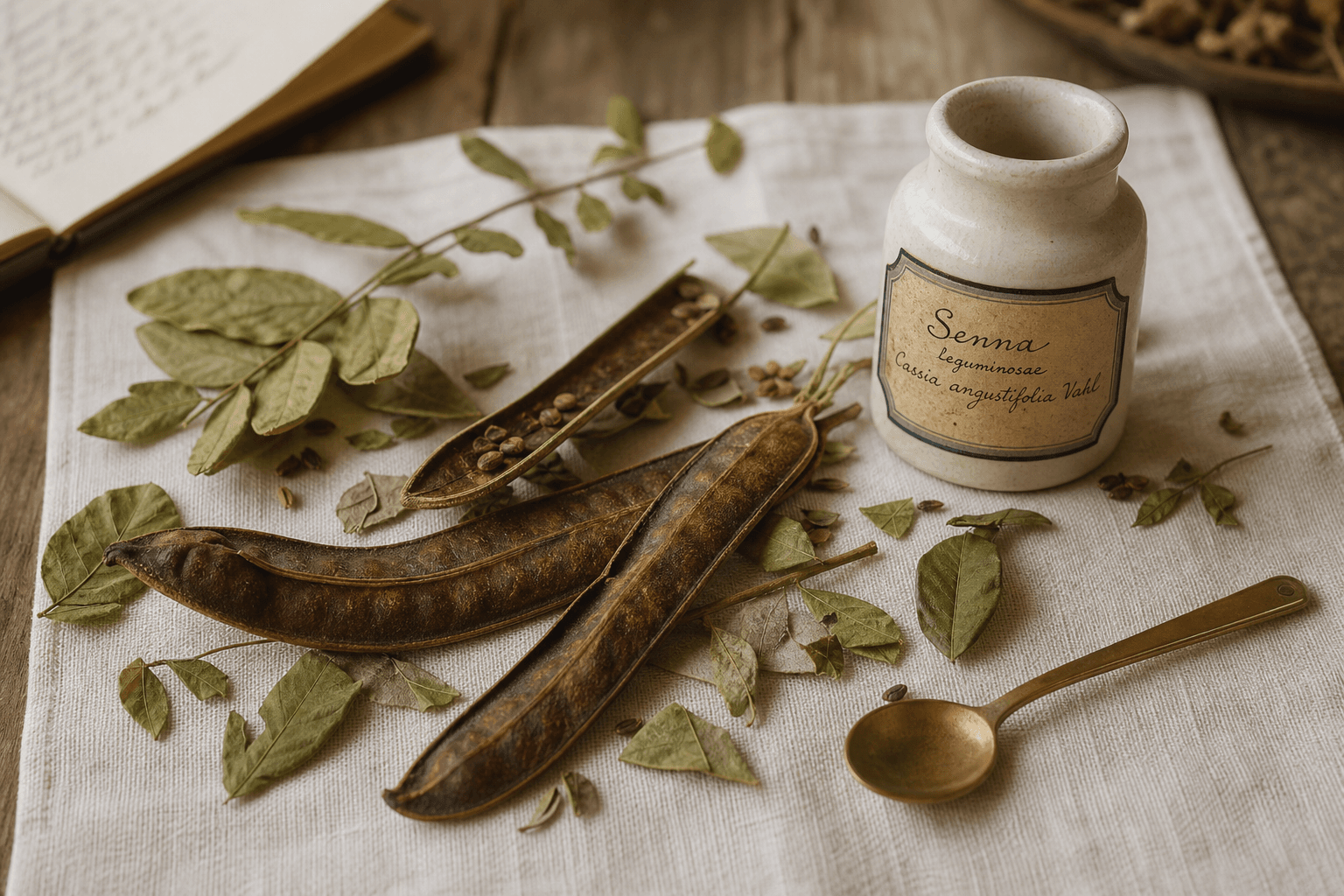
Whole dried pods of Senna alexandrina, identified to species, shade-dried, and traced from Wadi Hadramawt. The Prophetic reference is graded as Reported, pharmacology is acknowledged, and duration of use is clearly limited. This is not a daily food and no detox claim is made.
Historical use
Senna appears in pre-Islamic Mediterranean pharmacopoeia and was later integrated into Arabic medical writing under related names.
Ibn al-Qayyim lists senna among laxative simples and records caution regarding excess use.
Historical institutions used senna in decoction, often with moderating agents. This dispensation is provided as pod only for deliberate preparation.
Traditional scholarship
Commentators distinguish sanā makkī from related species, and botanical identity remains central to safe practice.
Ibn al-Qayyim and later writers classify senna among purgative simples for occasional support rather than routine daily use.
Where isnād discipline requires, the grade is stated as Reported and not elevated beyond that grade.
Traditional usage
- Traditionally prepared as a decoction from whole or lightly crushed pods, then strained and taken in modest measure.
- Classical authors discuss cleansing actions; this monograph frames use as occasional support rather than daily habit.
- Some historical texts combine senna with moderating simples.
Every remedy is documented to source. We state what we know, name what we do not, and dispense means with clear limits
Origin, cultivation, and harvesting
Origin
- Cultivated in Wadi Hadramawt, Yemen, with field and drying batch traceability.
Cultivation
- Senna alexandrina is grown as a field crop with rotation records that reduce adulterant risk.
Harvesting
- Whole pods are hand-sorted to remove stem fragments and foreign matter.
- Pods are shade-dried rather than oven-dried to preserve colour and constituent profile.
Quality assurance
- Light-protective packaging is used, with desiccant where humidity risk warrants.
- Decoction instructions and limits are printed on the inner label.
- Species name appears on each vessel rather than generic labelling.
Storage
- Store in sealed pouch in a cool, dry place.
- Reseal after opening and use within three months.
- Discard if mould, mustiness, or unexpected odour develops.
Preparation
- Lightly crush one to two pods, steep in approximately 200ml freshly boiled water for ten to fifteen minutes, then strain.
- Begin with the lower measure; first use in the evening is often practical.
- Use for short periods only, typically not more than several consecutive days without professional guidance.
Suggested use
Offered as a traditional dietary means and not as treatment for a diagnosed medical condition
- Use as an occasional decoction with modest measure and bounded duration.
- Read enclosed instructions before first use.
- Do not combine with other purgatives without competent advice.
Contraindications
- Healing is from Allah; this remedy is a means.
- For occasional use only and not as a daily food; no detox claim is made.
- Not during pregnancy, while nursing, or for children under twelve.
- Persistent change in bowel habit requires medical assessment.
- Not a substitute for medical care.