

Scope · Intended cohort · Commitments
Overview
Programme scope
- The Hijāma Diploma is a structured programme in ḥijāma, taught within the Prophetic tradition and aligned with contemporary clinical safety standards. It is a formal course of professional training, not a short workshop or remote class.
- The curriculum combines transmission (graded Prophetic reports and classical texts), supervised clinical practice, and assessed competence. Graduates receive the institution's Certificate in Prophetic Cupping after successful completion of all modules.
- Teaching is delivered in person. Competence is developed through supervised practice on consenting volunteers, not through video learning or unsupervised observation.
- The Academy teaches dry cupping (vacuum without incision) and wet cupping (ḥijāma, controlled bloodletting after puncture). Both are taught with the classical CPC sequence and institutional infection control standards.
Intended cohort
- Qualified healthcare professionals, including physicians, nurses, physiotherapists, and allied roles, who wish to include ḥijāma within scope of practice with clear limits and referral pathways.
- Practitioners of Prophetic Medicine with prior training in anatomy, infection control, and first response, or those who complete the prerequisite pathway.
- Residents of the United Kingdom, or applicants who can attend in London for the full twelve-week term without exception.
- Applicants who understand that evidence for cupping in many conditions remains mixed, and who do not promise cure.
Commitments
- Attend all scheduled sessions. Absence beyond two excused days requires remediation before certification.
- Completion of pre-reading for each module. Assigned sources are required.
- Complete forty supervised cupping sessions on live models and consenting volunteers, with signed logs.
- Pass written and practical assessments, and follow the Academy clinical conduct policy throughout enrolment.
- Maintain professional dress, punctuality, and audit-standard documentation from the first clinic hour.
Learning outcomes
Outcomes
Assessed outcomes are published before enrolment and reviewed prior to examination
- State the graded Prophetic reports on ḥijāma and distinguish Established from Reported narrations without conflation.Assessed
- Describe surface anatomy, classical sites, and contraindications recognised by the institution, including bleeding disorders, anticoagulation, pregnancy, acute infection, and cardiovascular risk.Assessed
- Perform dry cupping and wet cupping (CPC sequence) to institutional standard under direct supervision.Assessed
- Maintain sterility, informed consent, instrument processing, and clinical records to ICS-003 audit standard.Assessed
- Identify when to refer to a physician, articulate limits clearly, and avoid attributing cure.Assessed
- Recognise expected local effects (erythema, circular marks) versus complications requiring referral (infection, burns, vasovagal syncope).Assessed
- Situate ḥijāma within Tibb al-Nabawī and contemporary complementary practice without overstatement.Assessed
Curriculum · 7 modules
Curriculum
Foundations of Ḥijāma in the Sunnah
24 guided hours
Study of graded Prophetic reports, classical commentators, and the institutional editorial standard. Students learn to cite before making claims and to communicate with the same care in consultation.
Practical component: Seminar discussion and graded-source examination preparation.
Primary sources: Ṣaḥīḥ al-Bukhārī · Kitāb al-Ṭibb · Ibn al-Qayyim · al-Ṭibb al-Nabawī · Bab al-Ḥijāma
Anatomy, Physiology & Contraindications
32 guided hours
Surface anatomy, skin integrity, and vascular and neural considerations. Contraindications are taught without concession, aligned with institutional protocol and mainstream clinical guidance on who should not receive cupping.
Practical component: Palpation and marking exercises on models; contraindication case scenarios.
Primary sources: Institution Clinical Protocol CP-001 · StatPearls · Cupping Therapy (referenced)
Infection Control & Clinical Environment
20 guided hours
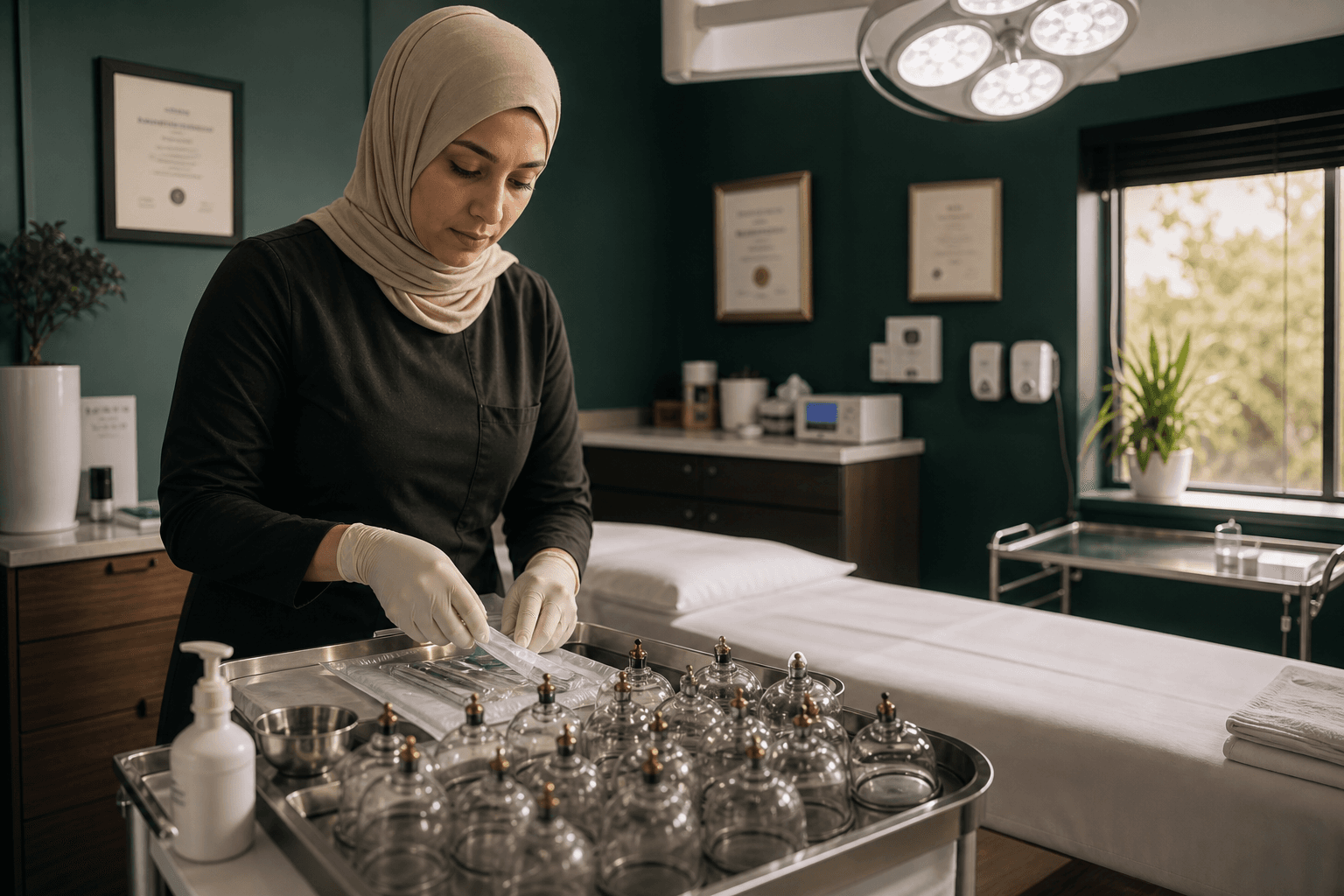
Sterile technique, autoclave cycle, single-use instruments where required, waste disposal, and room preparation. No session proceeds without daily ICS sign-off.
Practical component: Instrument processing drill; audit checklist completion under supervision.
Primary sources: Institution Infection Control Standard ICS-003
Dry Cupping: Technique & Supervision
28 guided hours
Vacuum methods (manual pump and modern suction), including static and sliding application. Duration, pressure, and cup count are adjusted to site and patient context, typically three to seven cups per region in teaching clinic.
The teacher is named before the subject. The chain is stated before the curriculum. Assessment criteria are published before enrolment opens
Practical sessions
Supervised practice
Faculty
Faculty
Facilities
Facilities
Clinical standards
Clinical standards
Assessment
Assessment
- Module I: written paper on graded reports and classical commentary. Pass mark is 70%. One remediation attempt is allowed.
- Modules II-III: practical checklist signed by supervisor. Candidate must pass or remediate before live volunteers.
- Modules IV–V: clinical log of forty supervised sessions; each signed. Quality review at sessions 20 and 40.
- Module VI: consent and documentation case study. Candidate must pass or remediate.
- Final written paper WP-Ḥ1: anatomy, contraindications, and ethics. Pass mark is 70%.
- Final OSCE CR-Ḥ1: fifteen-minute supervised wet cupping on consenting volunteer, two examiners, rubric published at enrolment.
- Second failure on any component requires re-enrolment in the following cohort at the candidate's expense.
Clinical practice standards during term:
- Supervised clinic operates twice weekly during term: Tuesday evening and Saturday morning.
- Volunteers are recruited through institutional correspondence and are never paid for participation. Consent is documented per CF-Ḥ1.
- Students do not practise on one another without explicit consent and supervisor presence.
- Expected local marks (circular erythema) are explained to volunteers before treatment.
- Adverse events reported immediately to Programme Director; vasovagal response protocol posted in every bay.
- Referral pathways to NHS and private physicians established before first live session.
- The institution carries clinical indemnity for supervised sessions only, not for unsupervised graduate practice.
Certification
Certification
- The Certificate in Prophetic Cupping is issued after successful completion of all seven modules, forty supervised clinical sessions, written examination (pass 70%), and practical OSCE.
- Certification confirms training completed to the institution's standard. It is not an NHS licence, not GMC registration, and not permission to practise medicine independently where law prohibits.
- The certificate carries a unique number, cohort date, and examining board names. Verification is available to employers and regulators on written request.
- Graduates must comply with local law and professional regulation. Continued adherence to institutional clinical protocols is expected. Refresher days are available.
Entry requirements
Entry requirements
- Minimum age is twenty-one.
- Healthcare qualification (MBBS, nursing registration, physiotherapy, or equivalent), OR Foundations of Prophetic Medicine with distinction and the Anatomy prerequisite short course.
- Current Enhanced DBS certificate (United Kingdom), or equivalent background check for international applicants.
- First Aid at Work certificate dated within the last three years.
- Written application (~500 words): prior study, motivation, and understanding that ḥijāma is a means, not a cure. Applications are reviewed by faculty.
- Interview with the Programme Director. Not all applicants are accepted. Decisions are made on clinical and academic grounds.
- Ability to attend the full term in London without partial remote attendance.
Equipment list
Equipment
| Item | Specification | Supplied by |
|---|
Course handbook
Course handbook
Student guide
Student guide
Gallery
Gallery
Graduate attestations
Graduate attestations
Published with explicit consent. Initials are used unless full attribution is requested by the graduate. Statements are attestation records, not promotional copy
“The sourcing discipline changed how I speak to patients. Technique standards were strict, and sign-off came only when the required depth was demonstrated.”
“I had completed a weekend course elsewhere. This programme clarified what I still needed to learn. The OSCE was fair and demanding.”
“The faculty did not use sales language. They corrected my incision technique in week six and required improvement. That is what professional training should involve.”
“Contraindications were central to training and assessed before any volunteer contact. I trust the certificate because of the standard required to earn it.”
Graduate pathways
After certification
Policies
Policies
Application
Enrolment
Fee includes clinical materials, assessment, certification, and supervised clinic access. Instalments are available on request with no interest. Review the full programme before submission. Each application is evaluated on academic readiness and clinical suitability
Send application